Durand Mercantile riot
News of the WorldThe Durand Mercantile riot turns a newspaper reading into a public brawl, making visible the political divisions already gathered in the room. In Durand, Texas, Jefferson Kyle Kidd tries to bring news of a wider world to a tense audience; instead, disputes over newspapers, Reconstruction politics, and authority culminate in fists, broken furnishings, and money trampled underfoot. The wreckage leaves Kidd with a private, practical obligation: he must recover the coins scattered across the floor because of Johanna Leonberger.
A Reading in a Divided Room
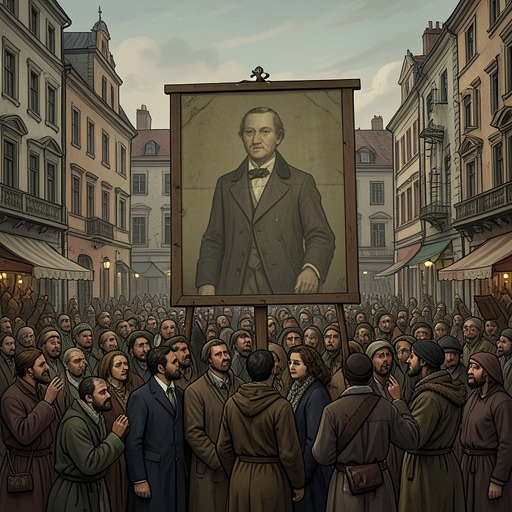
The Mercantile fills early. A United States Army soldier stands outside and requires each man to open his coat to show that he is not carrying a handgun. Several men have revolvers, including one small two-shot pistol, but the sergeant says nothing about the illegal weapons and gestures them toward a bench. Inside, men and women sit in stiff-backed chairs or stand by the counters. J. D. Allan, the proprietor, keeps them from leaning against the glass cases. The display goods—boots, suspenders, hair dye, buttons, English ironstone plates—place this argument over Texas politics amid the ordinary merchandise of a commercial room.
Kidd begins with the sort of local information his listeners expect from a traveler: the condition of the roads. The roads along the Red River are good, he says; he cannot speak for the Little Wichita, which he crossed more than a week before. The Brazos ferry is not operating, perhaps because it has washed away, though the landings on either side remain good and the road from the river to town is passable. He pauses, alert to whether anyone will bring up a recent firearms altercation at the Brazos. The listeners’ attention is elsewhere. Their faces and groupings already suggest a room divided, while thunder approaches from beyond the hundredth meridian.
News Meets Partisan Conflict
Kidd lays out his newspapers and Associated Press wire sheets, then reads from the Inquirer and the Tribune. His delivery is quick and steady, carrying reports from distant places: railroads, revolution in Chile, disputes over census-taking and women’s privacy in Punjab, and the changing value of tulip bulbs and Angora goats. The papers offer a view of a world in motion, but their reach cannot keep the local quarrel at a distance.
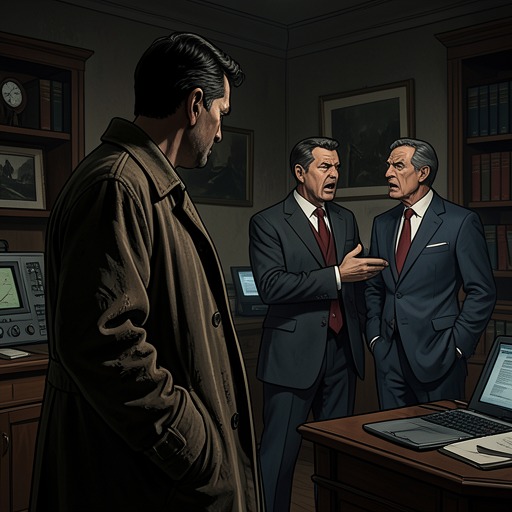
A listener calls for the Houston Tri-Weekly Union. Another man rejects it as a paper aligned with Davis. The dispute sharpens when a small blond man shouts that Davis will shut down the Dallas Courier under the Printing Bill and spend public money subsidizing radical newspapers. Two men rise face-to-face, shouting about Hamilton and Davis. Others try to separate them, but the effort to restrain the argument draws more people into its passions. The disagreement is not simply about which paper Kidd should read: the men invoke political loyalty, military rule, corruption in Austin, and the threatened power of the press. The reading has become a stage on which those conflicts can be voiced and contested.
The Fight and Its Damage
The women leave, lifting their skirts as they make their way out. Several take the handguns from the bench, carrying away the weapons belonging to their husbands, fathers, or brothers. The Army sergeant listens to the shouts but stays where he is. His presence at the door has not prevented the weapons from entering the room, and now he does not intervene as the argument becomes physical.
Fists and chairs follow. As the storm breaks outside, a glass case splinters and the coin can overturns; men trample the coins underfoot. The hanging kerosene lamps swing, chairs are crushed, and the walls shake. One man breaks a Wedgwood commemorative plate over another’s head. A short man removes his belt and swings its buckle at the crowd. The two principal combatants—the hotel owner and a young schoolteacher with pale cheeks inflamed by acne and badly cut, spiky hair—strike and twist their way through the door and into the street. Everyone else follows. The account gives no resolution to their dispute; its immediate result is the dispersal of the crowd and the destruction left behind.
Kidd Among the Ruins
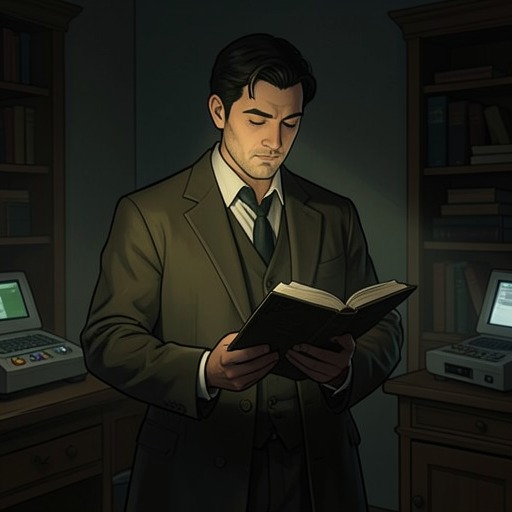
Kidd stays at the lectern for a few moments, chin resting on his fist as he surveys the damage. He folds the newspapers, returns them to his portfolio, and lets out a long breath. His thought turns to the Red River, where, in his estimation, the dangers are more legible: there are the Comanche, the Kiowa, and sometimes the United States Army. The comparison gives the local political violence an unsettling turn. A public reading intended to carry news has ended in a scene Kidd regards as worse than the hazards of the frontier.
He also thinks of Mrs. Gannet, who is in North Texas. Then he walks among the overturned chairs and sees the silver coins scattered across the floorboards, glinting like eyes. Picking them up means getting down on his hands and knees and groveling through the wreckage. He would otherwise have left the coins and walked away, but Johanna Leonberger changes what he is willing to do. The riot therefore ends not with a public settlement or an intervention by the soldier, but with Kidd’s reluctant return to the floor to gather what the crowd has scattered. Political fury has broken the room apart; his concern for Johanna gives him a reason to remain and recover something from it.